
???? What Is Battery Cycle Life? Why Different Manufacturers Use Different Standards for SOH, DOD, and EOL
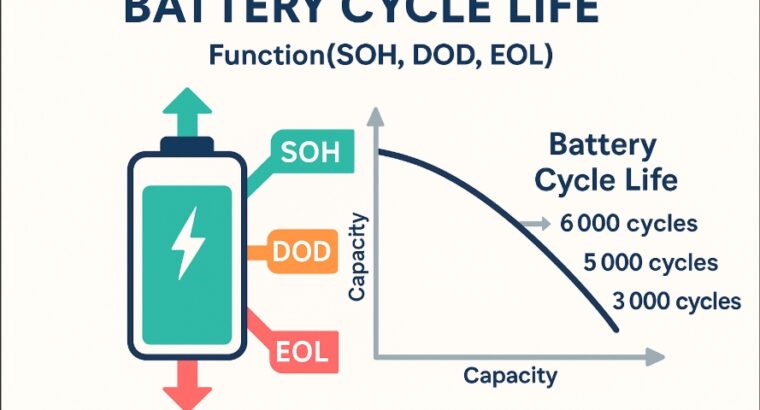
Battery Cycle Life: When you buy a battery — whether it’s for your EV, your solar system, or your drone — you’ll probably see the term cycle life. But what does it really mean?
Is 5,000 cycles better than 3,000? Why does the same company sometimes list different cycle life numbers for the same battery model?
This blog breaks it all down in clear, simple language so you can compare batteries properly and avoid misleading specs.
✅ What Is Battery Cycle Life?
In plain terms, battery cycle life means the number of times a battery can be fully charged and discharged before it loses too much capacity to be useful.
???? One cycle = 100% discharge + 100% recharge.
???? Multiple partial discharges add up to a full cycle. For example:
- Discharge 50% → recharge → discharge 50% → recharge = 1 cycle.
A lithium battery rated for 5,000 cycles should give you about 5,000 full charges and discharges before its capacity drops below a certain limit.
⚡Battery Cycle Life: Why Do Different Companies Use Different Standards?
This is the trickiest part — and where a lot of confusion happens.
Imagine two companies using the same battery cell. One advertises “5,000 cycles,” while another says “6,000 cycles.” Is one lying?
Not necessarily — they may just be using different testing conditions:
???? The three big factors that change the cycle life number:
1️⃣ DOD (Depth of Discharge)
2️⃣ SOH (State of Health)
3️⃣ EOL (End of Life)
???? 1) Depth of Discharge (DOD)
What it is: How much of the battery’s capacity you use during each cycle.
- 100% DOD = full discharge every time.
- 50% DOD = you only use half the battery each cycle.
Why it matters:
The deeper you discharge the battery, the more stress it undergoes — so the cycle life drops.
Example:
- A battery tested at 80% DOD will usually have a shorter cycle life than the same battery tested at 50% DOD.
???? 2) State of Health (SOH)
What it is: The current condition of the battery compared to when it was new.
A battery’s SOH drops as it ages. When a test says “SOH: 80%,” that means the battery still holds 80% of its original capacity.
Why it matters:
A battery’s cycle life is defined up to the point where its SOH hits a certain limit. Some companies choose 80% SOH, others might use 70% to get a bigger cycle number.
???? 3) End of Life (EOL)
What it is: The point when the battery is no longer useful for its intended application.
EOL is basically the SOH threshold at which the battery is considered ‘dead’ for practical use.
Why it matters:
The lower the EOL threshold, the longer the battery will appear to last — but you’ll have to accept a larger drop in capacity.
???? Battery Cycle Life: So Why Different Numbers on the Data Sheet?
It’s all about how the test is done.
For example:
- Same cell, same chemistry.
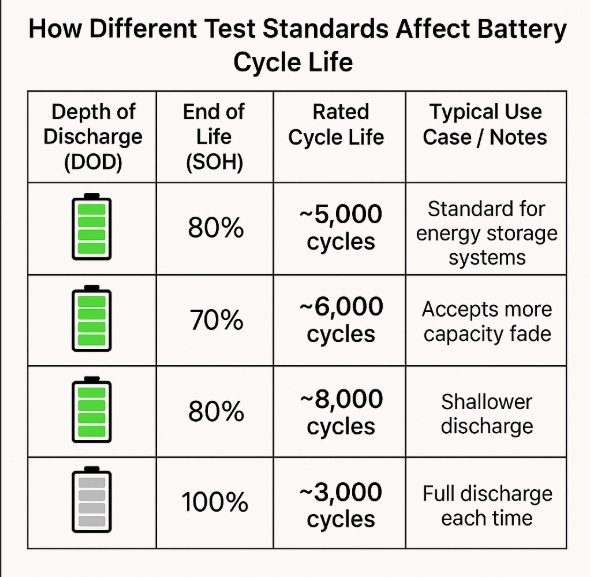
- If you test at 80% DOD and stop when SOH hits 80%, maybe you get 5,000 cycles.
- If you test at the same DOD but accept SOH down to 70%, you might get 6,000 cycles.
- If you reduce DOD to 50% and keep EOL at 80% SOH, you might get 8,000 cycles.
⚡ Why Do Companies Do This?
It’s not “cheating” — it’s about:
✅ Showing how the battery performs in different real-world applications.
✅ Helping customers pick the right cell for their usage.
✅ Positioning their product for marketing.
An EV battery might be rated more conservatively, because you don’t want your car to lose range too quickly.
A home storage battery might accept deeper cycling and faster capacity fade, if that’s cost-effective.
???? Real Example: How Different Test Standards Affect Cycle Life
Here’s a clear table to show how these factors play out:
| Depth of Discharge (DOD) | End of Life (SOH) | Rated Cycle Life | Typical Use Case / Notes |
|---|---|---|---|
| 80% | 80% | ~5,000 cycles | Standard for energy storage systems (ESS) where deep cycling is normal |
| 80% | 70% | ~6,000 cycles | Accepts more capacity fade, so more cycles before “end of life” |
| 50% | 80% | ~8,000 cycles | Shallower discharge; battery is under less stress, so cycle life is longer |
| 100% | 80% | ~3,000 cycles | Full discharge each time; more stress, fewer cycles |
✅ Same cell — different test conditions — different numbers!
????️ Battery Cycle Life: Why This Matters for Buyers
Always check:
- The DOD the test used.
- The SOH or EOL cutoff.
- The temperature (often 25°C for standard tests).
- The current rate (C-rate) — high currents can reduce life too!
???? If you don’t see these details, ask for the full test report!
Comparing only the cycle life number alone is misleading.
???? FAQ: Battery Cycle Life
???? Q1: What does “one cycle” actually mean?
A full cycle means using 100% of the battery’s capacity once. Partial discharges add up to a full cycle.
???? Q2: Is higher cycle life always better?
It depends on your application. A longer cycle life is great, but not if it sacrifices power or energy you actually need.
???? Q3: Why do some companies show EOL and others show SOH?
EOL is defined by SOH — they’re linked. But companies sometimes only show one or the other. Always clarify the actual capacity drop they allow.
???? Q4: What’s the standard SOH threshold?
80% is common for EVs and ESS. Some industrial uses may accept down to 70% or even 60% if the economics work.
✅ Key Takeaway
Cycle life numbers are not universal truths — they are test results under specific conditions.
When you know how to read DOD, SOH, and EOL, you can compare batteries fairly and choose the right one for your needs.


Comments are closed.




[…] this guide, we’ll walk through the essential UL standards that every battery manufacturer, integrator, and developer must understand to stay compliant and […]